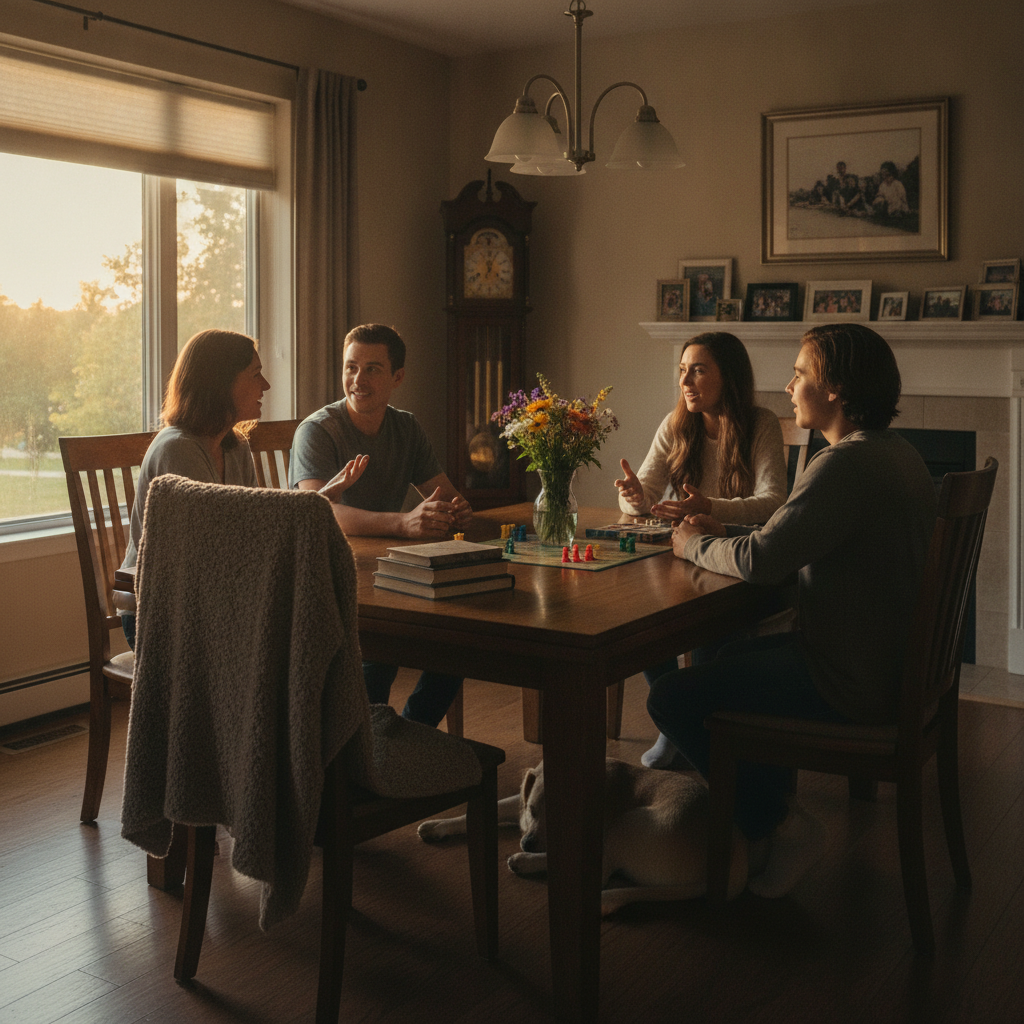
Silence, in a household that has grown accustomed to the hum of devices, can feel almost foreign at first — slightly uncomfortable, then gradually expansive. There is something quietly radical about choosing, as a household, to set down the phones and close the laptops not because the power has gone out, but because the hour demands it. This is not a new idea dressed in modern language. Cultures around the world have long protected certain windows of time from the encroachment of productivity and distraction, recognizing that without deliberate rest from stimulation, the capacity for genuine connection begins to erode almost imperceptibly. What has changed is the scale of the encroachment, and the degree of intention now required to resist it.
The Fragmentation That Accumulates Quietly
Most households don't notice the moment when devices become the default mediator of domestic life. It happens in stages — a phone checked during a shared meal, a television running as ambient noise during conversation, a child's attention split between a tablet and the dinner table. Each individual instance seems harmless, and in isolation it probably is. But the cumulative effect is a kind of attentional fragmentation that researchers and educators have documented for years: the sense that no exchange feels fully inhabited, that conversations end before they properly begin, and that presence itself has become a scarce resource even among people who share a home. The Japanese concept of *ma* — the meaningful pause or interval between things — captures what's being lost. When every gap is filled with a screen, the space in which real thought and real connection form simply disappears.
What a Weekly Window Actually Looks Like
The structure of a technology-free window matters more than its length. An hour of intentional disconnection on a Sunday afternoon, or a two-hour stretch on a weekday evening, can accomplish more than sporadic, guilt-driven breaks scattered through the week. The key is consistency — the same approximate time, the same household agreement, week after week. What fills that window tends to evolve naturally: early sessions might feel awkward, populated by the odd silence of people who've forgotten how to simply be in a room together. Over time, the window tends to fill with things that had been quietly crowded out — card games, cooking something unhurried, a walk through a neighborhood like Brooklyn's Carroll Gardens or Portland's Ladd's Addition, or simply a conversation that doesn't have a purpose beyond itself.
The practical choreography is simpler than most households expect. Devices are placed in another room — not hidden, not dramatically surrendered, just relocated. Apps like Freedom or Screen Time can be used during the rest of the week to build awareness of usage patterns, making the weekly window feel less like deprivation and more like balance. Households with children often find that the resistance is stronger from adults than from kids, who adapt quickly once the window becomes routine rather than exception.
Attention as a Renewable Resource
There is a useful way of thinking about attention that doesn't require any technical vocabulary: it behaves like a muscle that fatigues with overuse and recovers with rest. Continuous partial attention — the state of being almost focused on many things simultaneously — is the dominant cognitive mode of contemporary life, and it exacts a cost that accumulates slowly but compounds over months and years. The technology-free window is, among other things, a recovery period. Neuroscience has increasingly supported what contemplative traditions have long argued: unstructured, low-stimulation time is not wasted time. It is when the mind consolidates, when empathy reactivates, and when the slower, more considered forms of thought that underpin good decisions and good relationships are allowed to surface. This is the kind of rest that a podcast or a scroll cannot provide.
Households that establish this practice consistently report something that is difficult to quantify but easy to recognize: the quality of conversation changes. Not immediately, and not dramatically — but over weeks, the texture shifts. People finish their sentences. Stories get told in full. Children describe things from school that they wouldn't have mentioned otherwise, not because they were asked, but because the space existed to receive them. The Danish concept of *hygge* — a word that resists clean translation but encompasses warmth, ease, and shared presence — is not manufactured by candles or hot drinks alone. It emerges from the conditions that allow people to relax into each other's company, and those conditions require time protected from interruption.
The Longer Arc of a Simple Practice
A weekly technology-free window is, at its core, a form of household values made visible. It communicates something — to children especially — about what the household considers important enough to protect. In the same way that a family dinner ritual or a Sunday morning walk becomes part of a household's identity over time, the weekly window accrues meaning through repetition. It becomes a point of reference, something the week is organized around rather than squeezed between. The practice doesn't require a philosophy or a manifesto. It simply requires an agreement and the mild discipline of keeping it.
For households that find the transition difficult, it helps to think of the window not as an absence of something but as the presence of something else — the kind of low-pressure togetherness that doesn't ask anything of anyone, that has no agenda and no performance requirements. Anthropologists use the phrase *liminal time* to describe periods that exist outside ordinary structure, when normal rules are suspended and something different becomes possible. The weekly window is a small, domestic version of that: a threshold crossed together, into a version of the household that is a little slower, a little quieter, and perhaps a little more recognizable as home.
The household that first sat together in that unfamiliar silence — unsure what to do without a screen to turn to — eventually finds that the silence wasn't empty at all. It was full of what had been waiting patiently to be heard: the small observations, the half-formed ideas, the conversations that don't require a reason to begin. That is what the window is for, and that is what returns when it is given the chance.