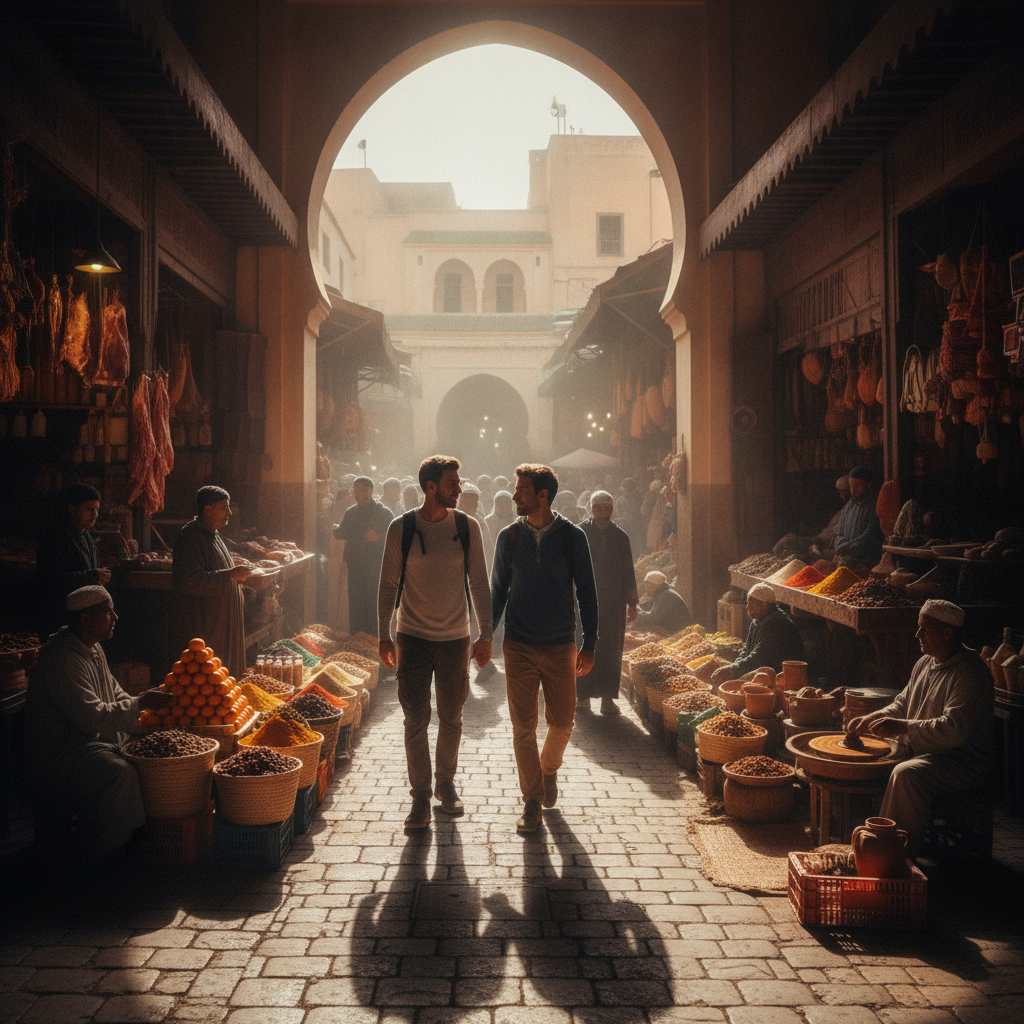
There is a version of travel that begins at the hotel breakfast buffet, with its predictable array of pastries and instant coffee, and another that begins at the edge of a market stall, where someone is slicing papaya with practiced efficiency while the city hums into its morning rhythm. Most experienced travelers know which version teaches more, yet the pull of familiar comfort can override good instincts, especially on the first day of a trip when jet lag and uncertainty make the path of least resistance feel like wisdom. That first morning, it turns out, carries more weight than most itineraries suggest.
What a Market Reveals Before Noon
A central market — whether it's the Boqueria in Barcelona, the Chatuchak Weekend Market in Bangkok, or the sprawling Mercado Central in Santiago — functions as a kind of social nervous system for the places it serves. Vendors arrange their goods according to what is seasonal, affordable, and culturally prized, none of which appears in guidebooks with the same clarity. The density of a fish section versus a spice section, the presence of prepared foods versus raw ingredients, the ratio of local shoppers to tourist browsers — all of it forms a kind of text that a willing observer can begin to read within an hour. Prices scrawled on cardboard, the casual transactions between neighbors who recognize each other across the stalls, the smell of something being grilled at seven in the morning: these details accumulate into an understanding that no museum exhibit can replicate, because they are not curated for outside consumption. They simply are.
The anthropological concept of a *souk* — the Arabic term for a traditional market, often used broadly to describe any bazaar or covered marketplace — carries within it an entire theory of how communities organize around commerce and conversation. Even in markets where that specific word doesn't apply, the underlying logic does: the market is where the community negotiates what it values, and watching those negotiations in real time is one of the most honest forms of cultural education available to a traveler. A visitor who spends ninety minutes at a local mercado on the first morning arrives at the rest of the trip with a mental baseline — a sense of what things cost locally, what ingredients define the regional cuisine, what the pace of social exchange actually feels like — that reshapes every subsequent experience.
The Economic Intelligence Hidden in Stall Prices
Beyond the sensory education, there is a practical dimension that travelers often overlook. Central markets establish the real economy of a place in a way that tourist-adjacent restaurants and hotel gift shops deliberately obscure. When you see that a kilogram of local cheese costs the equivalent of two dollars at a covered market in Oaxaca, you carry that knowledge into every meal you eat for the rest of the trip. When you watch locals in Lisbon's Mercado da Ribeira pay a certain amount for a pastel de nata — the celebrated custard tart that has become almost synonymous with Portuguese café culture — you have a quiet benchmark against which to measure every inflated version sold in the historic center. This kind of price literacy is not about being miserly; it's about understanding what fair value looks like in a specific context, which is ultimately what separates travelers who feel cheated from those who feel they got the most out of every euro or baht or peso spent.
The market also signals which ingredients are worth seeking out in restaurants. If a particular herb or grain dominates the fresh produce sections — if vendors are selling it in abundance, if it appears in multiple forms across different stalls — that ingredient is almost certainly central to the region's culinary identity. A traveler who notices that dried ñora peppers appear everywhere in a Spanish market might later recognize them as the quiet foundation of a restaurant's romesco sauce, connecting the experience across contexts in a way that feels genuinely earned.
Reading the Rhythm Before the City Speeds Up
Markets are at their most revealing in the early hours, before the tourist wave arrives and alters the social dynamics. The morning market has a particular pace — purposeful but unhurried — that reflects how the local population actually moves through its day. Vendors set up with practiced efficiency. Regulars conduct transactions that are almost wordless in their familiarity. Arguments break out and resolve quickly over the price of something perishable. There is an emotional temperature to all of this that settles into the traveler's understanding of a place far more durably than any formal tour.
This is where the concept of *terroir* — borrowed from wine culture, referring to the environmental conditions that give a product its distinctive character — becomes useful as a metaphor. Every destination has a kind of human terroir: the combination of history, climate, economy, and social habit that produces a distinctive way of being in the world. The market is one of the few places where that terroir is expressed simultaneously across multiple dimensions. The food reflects the land. The transactions reflect the social norms. The sounds and smells reflect decades of accumulated practice. A traveler who arrives early enough to witness all of this before the morning disperses carries a richer map of the place — one that remains useful long after the official sightseeing begins.
Making It Work on Your First Trip Day
If you want the market to function as a genuine orientation rather than just a scenic detour, arrive with a few simple intentions. Walk the full perimeter before buying anything, noting which sections draw the densest crowds and which goods appear in multiple stalls. Eat something small from a prepared-food vendor — not the most tourist-obvious option, but whatever the person ahead of you ordered. Resist the urge to photograph everything immediately; spend the first twenty minutes just watching. Listen for the language patterns, the humor, the way vendors address different kinds of customers. Try to use a local phrase — even something as simple as *quanto custa* in Portuguese or *ราคาเท่าไหร่* in Thai — not to bargain aggressively but to signal good faith and invite a different quality of interaction.
The cultural tone set by that first morning at the market carries forward in ways that are difficult to fully anticipate in advance. It shapes how you read menus, how you negotiate, how you move through neighborhoods, and how you understand the gap between the version of a place marketed to visitors and the version actually lived by its residents. Just as the traveler who begins with that hotel breakfast buffet tends to stay within the comfortable orbit of predictable experiences, the one who begins at the market tends to keep finding their way back to the edges of a place where something real is happening — which is, in the end, what most people are actually looking for when they leave home.