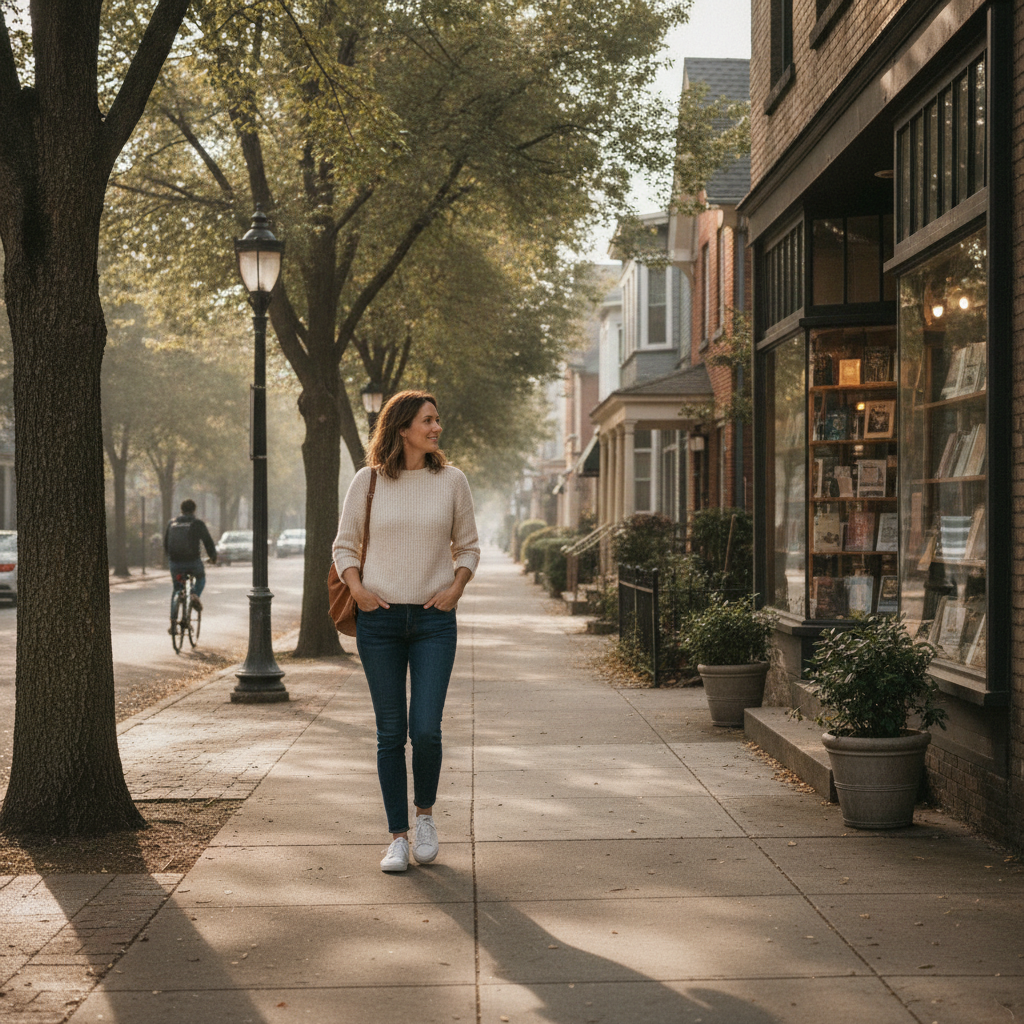
Most people know their neighborhood the way they know a familiar commute — by its obstacles and utilities, by what slows them down or gets them where they need to go. The dry cleaner. The shortcut past the parking garage. The coffee shop with the fastest line. It's a kind of functional blindness, and it settles in gradually, replacing genuine familiarity with a kind of efficient indifference. The streets become infrastructure rather than place, and the community that exists within them recedes into background noise. One of the quietest ways to reverse this drift is also one of the simplest: a single weekend morning each month, alone, with nowhere specific to be and nothing that needs doing.
The Difference Between Errand Walking and Purposeless Walking
There is a meaningful distinction between walking as transportation and walking as attention. When a person moves through a neighborhood with a list — groceries, pharmacy, post office — the street becomes a means to an end, and perception narrows accordingly. The brain filters aggressively, retaining only what's relevant to the task. Purposeless walking operates on an entirely different register. Without a destination anchoring the route, perception opens outward. The eye catches the hand-painted sign above a Vietnamese bakery that's been there for years but never quite registered. The ear picks up the particular acoustics of a certain intersection — the way sound bounces between old brick buildings on a quiet morning. These are not trivial observations. They are the texture of place, and they accumulate into something resembling genuine belonging.
This practice has roots in the concept of the *flâneur* — a French term, originating in nineteenth-century Paris, describing a person who wanders through urban space with alert, unhurried curiosity. The flâneur is neither tourist nor commuter, but an observer who treats the city as a kind of living text. While the term carries a particular literary and historical weight, the underlying impulse is universal: slow, attentive movement through familiar space reveals things that speed and purpose consistently conceal.
Why Solitude Matters More Than Company Here
The instinct to bring a friend or partner along is understandable, and in many contexts entirely welcome. But for this specific practice, solitude is the point. Conversation redirects attention inward, toward the relationship and the exchange of ideas, rather than outward toward the environment. Walking alone removes that competing claim on perception. A person walking without company tends to notice more — a different pace asserts itself naturally, pauses happen without requiring explanation, and the walk can follow curiosity rather than compromise. Neighborhoods in cities like Portland's Sellwood district, Brooklyn's Carroll Gardens, or Chicago's Logan Square reward exactly this kind of patient, unscheduled attention, where a turn down an unfamiliar block can reveal a community garden, a mural in progress, or a pocket park that somehow escaped notice for years.
Solitary walking also creates a kind of low-level self-inventory that busy social schedules rarely allow. The rhythm of footsteps, the absence of agenda, and the mild sensory engagement of moving through a familiar yet freshly observed environment tend to surface quiet thoughts and half-formed ideas that busier hours crowd out. Urban planners and behavioral researchers have long noted that pedestrian movement — particularly aimless pedestrian movement — is one of the conditions most strongly associated with a felt sense of community connection.
What Gradually Returns Through This Practice
After several months of these walks, something shifts in how a neighborhood registers. Streets that once felt interchangeable develop distinct personalities. The block with the enormous silver maple that turns gold by mid-October. The corner where two elderly men reliably sit on a stoop on Sunday mornings, speaking in a language that might be Greek or might be Albanian. The independent hardware store — the kind that stocks odd fasteners and still cuts keys — that turns out to have been open for thirty-one years. None of this information is gathered intentionally, but it accumulates into a kind of intimate local knowledge that changes how a place feels to inhabit.
This is what geographers sometimes call *place attachment* — a psychological bond that forms between people and specific physical environments. It's distinct from habit or convenience. Place attachment involves recognition, memory, and a mild but genuine affection. It's what makes a person feel not just that they live somewhere, but that they belong somewhere. And unlike belonging to a social group, which requires ongoing reciprocal maintenance, place attachment is largely self-sustaining once established. The neighborhood doesn't need to know you. You simply need to know it.
Making This a Sustainable Monthly Practice
The logistical case for this practice is straightforward. One morning per month — roughly three hours, more likely two — requires almost no rearrangement of an ordinary life. The walk itself costs nothing. No app, no gear, no commitment beyond showing up without a list. Keeping it monthly rather than weekly matters: frequent enough to maintain continuity, infrequent enough to preserve the slight sense of occasion that makes the walk feel distinct from daily routine. Some people find it useful to pick a loose anchor — the second Sunday of each month, or the first clear morning after the new month begins — not as a rigid rule, but as a gentle structural prompt.
For those who live in denser urban environments, the practice scales naturally. A single neighborhood in a city like San Francisco's Mission District or Philadelphia's Fishtown contains enough variation in architecture, commerce, and street life to sustain months of new observation. For those in quieter suburban or small-town contexts, the same principle applies at a different scale — a residential grid of familiar streets, walked without purpose, reveals seasonal change, social patterns, and small domestic details that years of errand-focused movement never surfaced.
The practice asks for almost nothing except the willingness to be somewhere without needing to be somewhere else. That particular willingness, cultivated even occasionally, has a way of reshaping not just how a neighborhood feels, but how the life lived within it feels — less transactional, more inhabited. The street that once served only as a route becomes a place, and the person walking it becomes, in some quiet but real sense, a resident rather than a commuter passing through.