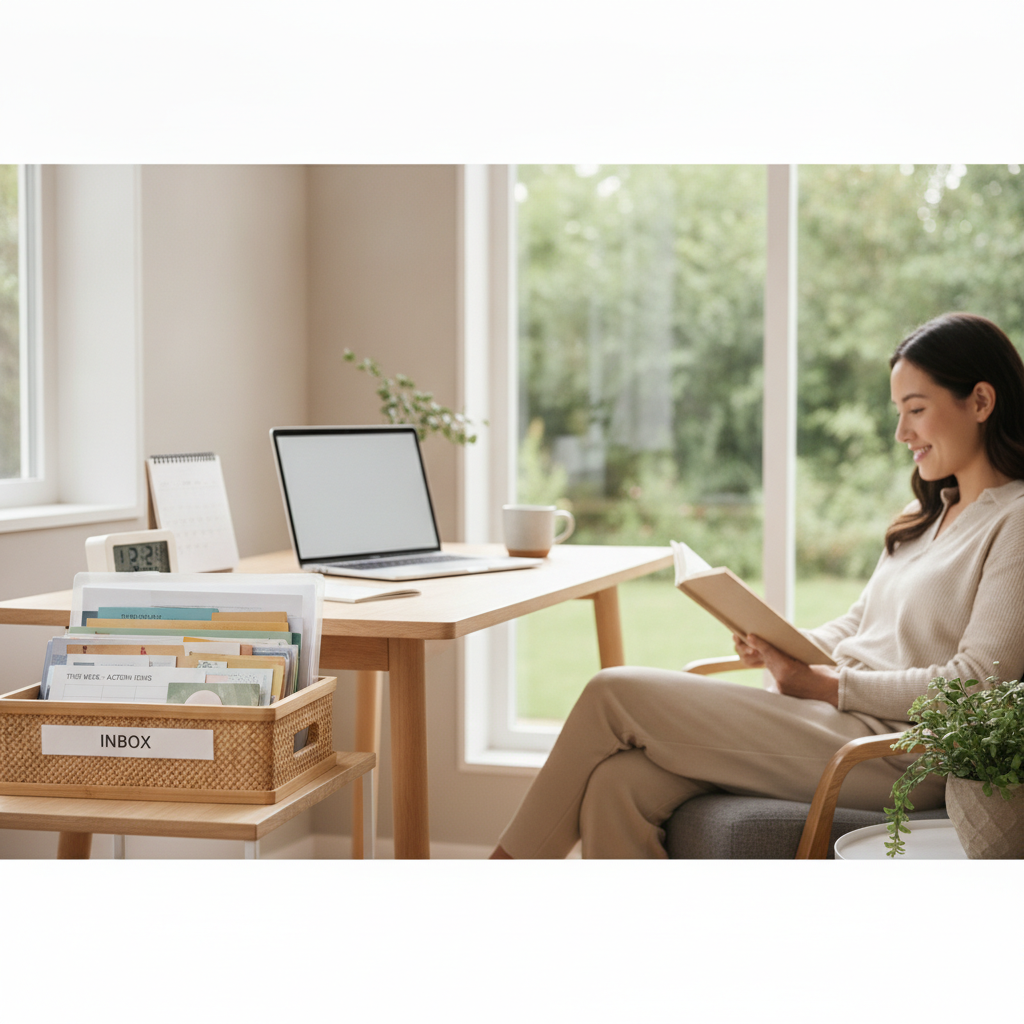
Paper has a way of multiplying when no one is watching. A utility bill lands on the counter, then a school permission slip joins it, then a medical explanation of benefits, then a coupon mailer you meant to look at. Within days, what started as a manageable stack has become an invisible weight — something you're aware of without ever quite addressing. That quiet accumulation is one of the more underrated sources of household stress, and it tends to bleed into evenings and weekends in ways that feel disproportionate to a pile of paper.
The fix isn't complicated, but it is specific. Assigning one dedicated physical inbox — an actual container, in an actual spot — for all incoming household paperwork changes the relationship between your home and your administrative life. It contains the chaos before it spreads.
The Difference Between a Landing Spot and a Dumping Ground
Most homes already have an unofficial paper landing spot: a corner of the kitchen counter, a spot near the front door, the edge of a desk. The problem is that an unofficial spot carries no rules. Anything goes in, nothing comes out, and the pile grows indefinitely. A designated inbox works differently because it's bounded. It has a clear purpose — incoming items that need attention — and that clarity alone changes how you treat what goes inside it. Tools like a simple wire tray from a brand like Staples or a labeled wooden bin from IKEA work well because they look intentional.
Why One Location Matters More Than You Think
When paperwork can land anywhere, your brain has to track multiple possible locations every time you need to find something. That low-level tracking is a genuine cognitive load, even if you don't notice it consciously. Centralizing incoming documents to a single, visible spot eliminates that tracking entirely. You always know where things are, which means you stop spending mental energy on that question. That recovered attention is surprisingly significant — it's one of those small-system wins that compounds quietly over time without requiring any dramatic behavioral change.
Setting a Weekly Processing Window Instead of Reacting Daily
One of the most practical habits that pairs with a physical inbox is processing it on a schedule rather than on demand. Checking the inbox daily often creates a fragmented workflow — you pick something up, realize you need to make a call or pull up an account, and then set it back down half-addressed. Instead, reserve one consistent window per week, even just twenty or thirty minutes, to move through everything in the tray. Apps like Todoist or a simple paper planner can hold any action items that come out of that session. The inbox collects; the weekly session decides.
Keeping the System Simple Enough to Actually Maintain
The most common reason household organization systems collapse is that they require too much upkeep. A physical inbox works precisely because it demands almost nothing of you between processing sessions. You don't need to sort by category as things arrive, you don't need subcategories or color coding, and you don't need to pre-file anything. The only rule is that paper with administrative intent — bills, forms, notices, correspondence — goes in the tray. That single rule is easy to follow even on a chaotic day, which is exactly when systems need to hold up.
What Happens When the Inbox Gets Processed Consistently
After a few weeks of consistent use, a reliable pattern emerges. You stop encountering surprise deadlines because you've seen every piece of paper before it became urgent. You stop losing bills or forgetting to respond to notices because items don't scatter across the house. The inbox also becomes a natural review moment — flipping through the week's accumulation often reveals patterns in household spending, medical billing, or subscription activity that wouldn't be obvious otherwise. It's a small administrative ritual that quietly improves financial awareness and household coordination at the same time.
Protecting Personal Time From Administrative Bleed
The less visible benefit of this system is what it does to your evenings and weekends. When paperwork has no home, it tends to surface as anxiety at inconvenient times — a half-remembered bill during dinner, a form you meant to sign appearing just as you're winding down. The inbox contains all of that. Because you know it's captured and that you'll address it on schedule, your brain is freed to be off-duty outside that processing window. The boundary between administrative time and personal time becomes real rather than aspirational, and that distinction matters more than most people realize until they experience it.
Building the Habit Around a Consistent Weekly Anchor
The most durable version of this system ties the weekly processing session to an existing routine. Sunday evenings work well for many households because they naturally sit at the edge between one week and the next. Others prefer Friday afternoons to clear the slate before the weekend. The specific day matters less than the consistency. Pairing the session with something pleasant — a cup of coffee, a familiar playlist — removes the friction of getting started. Over time, the habit becomes automatic, and the inbox becomes part of how the household runs rather than something that requires active motivation to maintain.
A single tray and a single weekly window isn't a complicated system, but simplicity is the point. The administrative layer of a home doesn't have to sprawl into every corner of your time and attention. When paperwork has somewhere to land and a scheduled moment to be addressed, it stops being a diffuse background stressor and becomes a contained, manageable task — one that stays in its lane and leaves the rest of your week alone.