There is a quiet moment that most people miss — the one just after waking, when the world outside is already organizing itself by light, and the body is waiting, quite literally, for a signal. The relationship between human biology and natural light is ancient, finely calibrated, and almost entirely overlooked in the design of modern mornings. Most people move through their first hour indoors, under artificial overhead bulbs, scrolling through blue-tinted screens before their eyes have ever met the sky. The result, accumulated over weeks and months, is a kind of low-grade disconnection — an energy that never quite arrives, a mood that starts flat and stays there.
The Body's Internal Clock and Light as Its Anchor
The circadian rhythm — from the Latin *circa dies*, meaning "about a day" — is the internal biological clock that regulates sleep, alertness, hormone release, digestion, and emotional tone across a roughly 24-hour cycle. It is not metaphorical. The suprachiasmatic nucleus, a small cluster of cells in the brain's hypothalamus, depends on light signals received through the eyes to stay synchronized with the actual time of day. When morning light enters the eye — particularly the broad-spectrum, high-intensity light of the outdoors — it triggers a cascade of neurochemical events: cortisol rises appropriately, melatonin production winds down, and serotonin synthesis begins ramping up. Without that signal, the body's clock drifts, and the downstream effects on energy, focus, and emotional regulation are real and measurable. Natural morning light is, in this sense, less a luxury than a biological requirement.
What a Morning Light Ritual Actually Looks Like
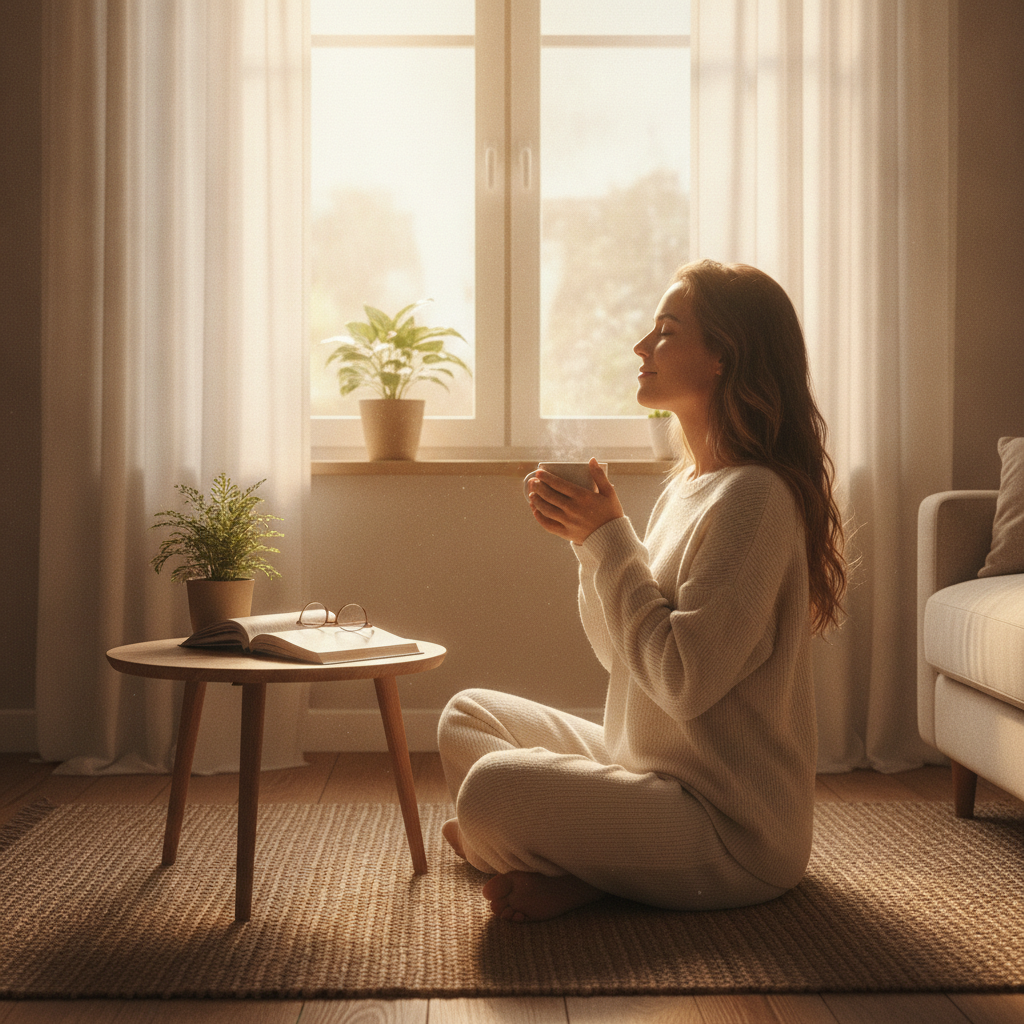
A ritual, as distinct from a routine, carries intentionality — it is performed with awareness rather than automatically. Designing a morning light ritual means creating a deliberate practice of early outdoor or window-facing light exposure, ideally within thirty to sixty minutes of waking. This could mean stepping onto a porch with coffee, sitting near an east-facing window during breakfast, or taking a ten-minute walk before engaging with a phone or screen. Apps like *f.lux* or devices from companies like *Philips Hue* can support indoor light environments, but they supplement rather than replace the real thing. On overcast days, even diffuse outdoor light carries significantly more lux — the unit measuring light intensity — than a well-lit indoor room. The ritual need not be elaborate; what matters is consistency and the conscious act of orienting oneself toward the light before orienting toward the day's demands.
The Mood Architecture of Early Light
Serotonin, often associated with mood stability and emotional resilience, is produced in greater quantities when the eyes register bright natural light in the morning. This is part of why seasonal affective disorder — sometimes called SAD, and recognized clinically as a light-deprivation condition — responds well to light therapy boxes that mimic outdoor intensity. But the connection runs deeper than a single neurotransmitter. Morning light exposure shapes the entire hormonal architecture of the day: when cortisol peaks appropriately in early morning in response to light, it creates a stable energy curve rather than the erratic highs and crashes that come from caffeine used as a substitute signal. Neighborhoods with walkable outdoor spaces, like those found near Seattle's Greenlake or Chicago's lakefront paths, make this kind of morning ritual structurally easy — but even an urban apartment balcony or a park bench at the end of the block serves the same biological purpose.
Light Hygiene and the Modern Interior
The concept of *hikari no ma* — a Japanese spatial philosophy that honors the quality and direction of interior light — reflects a cultural understanding that how light enters a living space shapes the psychological experience of being in it. Modern interior design has slowly rediscovered this, with architects and wellness-focused brands like *Velux* building entire product lines around maximizing natural daylight in homes. Light hygiene, as a practical concept, asks a simple question: is the environment designed to support the body's light needs, or working against them? Heavy curtains kept closed until mid-morning, workstations facing away from windows, and the habitual reach for artificial light before outdoor exposure are all small architectural choices that compound over time. Rearranging a morning chair to face a window, or establishing the habit of opening blinds as the very first act of the day, shifts the light environment without any cost beyond intention.
Sustaining Energy Into the Afternoon
The benefits of morning light exposure don't evaporate by nine o'clock. Research into circadian biology consistently points to a relationship between strong morning light anchoring and more stable alertness throughout the afternoon — the period when energy typically dips and focus fragments. When the body's clock is well-set by early light, the afternoon cortisol decline is gradual rather than abrupt, and the desire to compensate with stimulants diminishes. This is one reason why cultures with outdoor morning habits — Mediterranean café culture, the Nordic tradition of *friluftsliv* (open-air living), the Japanese practice of *shinrin-yoku* (forest bathing) — often report higher baseline energy without proportionally higher caffeine consumption. The morning light ritual is, in effect, an investment that pays interest across the full arc of the day.
Building the Practice Into Daily Life
For anyone looking to build this habit, the entry point is deliberately low. You don't need to wake at dawn, move to a sunnier climate, or purchase specialized equipment. Starting with five minutes of outdoor or unobstructed natural light within the first hour of waking — practiced consistently across a week — is enough to begin recalibrating the circadian signal. Pairing the light exposure with something already pleasurable, like a morning beverage, a brief walk, or a few minutes of quiet sitting, anchors the behavior without requiring willpower. Over time, the body begins to expect and respond to the cue, and energy starts arriving more reliably, without the unsteady quality that characterizes mornings built entirely indoors under artificial light.
There is something fitting about the fact that the solution to flat morning energy is also one of the oldest and simplest things available — the light that has been organizing living creatures for millions of years, waiting just beyond the window. The quiet moment after waking, which most people move through without a second thought, turns out to be the most important signal point of the entire day. How that moment is met — with screens and overhead bulbs, or with a deliberate turn toward the sky — shapes not just the morning, but the emotional and energetic texture of everything that follows.