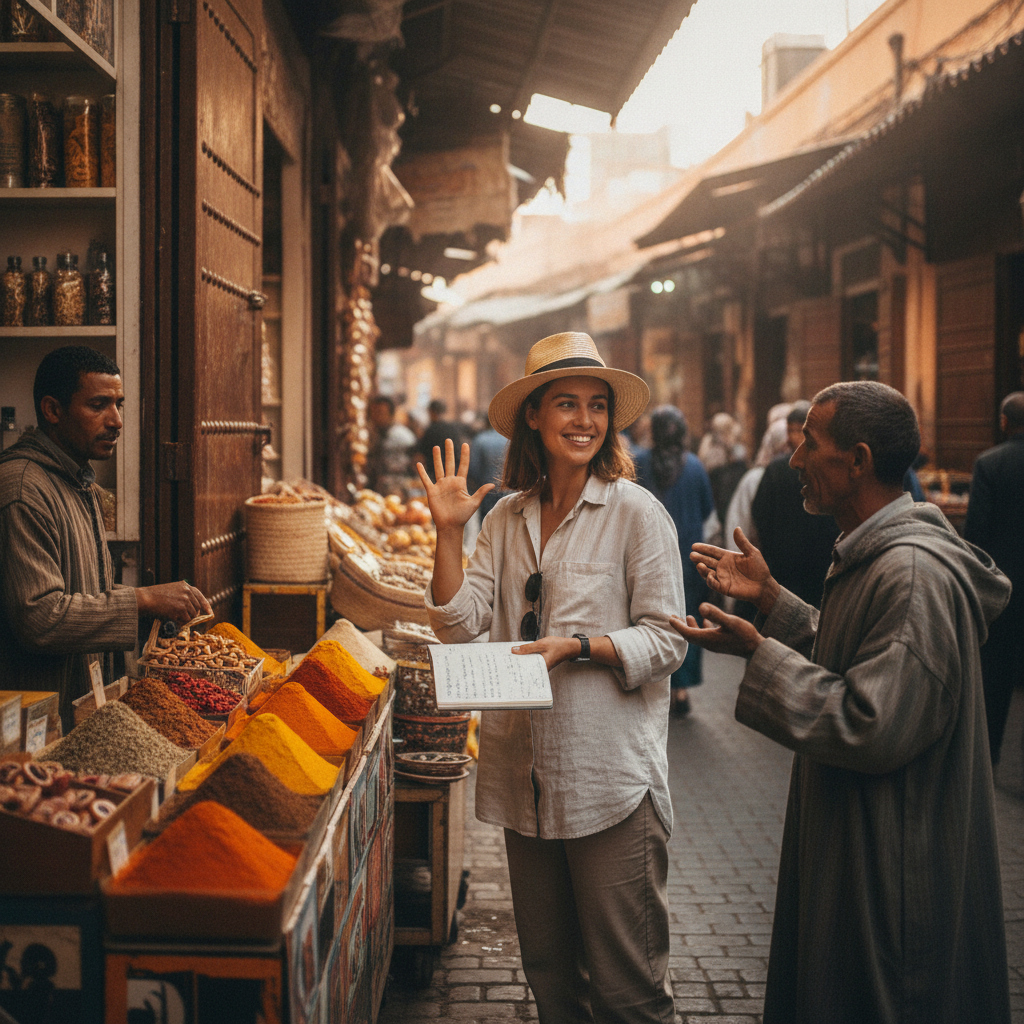
Language is not merely a tool for communication — it is a signal of respect, and locals read that signal instantly. The traveler who arrives in Oaxaca or Chiang Mai or Plovdiv armed with five carefully chosen logistical phrases occupies an entirely different social position than the one who holds a phone screen toward a stranger and points. One posture says *I made an effort for you*. The other, however efficient, says *I need something from you*. That distinction shapes every interaction that follows, from the quality of directions received to the warmth of a meal recommendation, and ultimately determines how much of a place a visitor actually gets to experience.
The Phrases That Matter Most for Getting Around
The five phrases worth prioritizing are not romantic or ambitious. They are logistical by nature: how to ask where a bathroom is, how to confirm whether a place is open, how to ask someone to repeat themselves more slowly, how to say *how much does this cost*, and how to express basic thanks with genuine inflection rather than a reflexive mumble. These phrases are intentionally modest. They do not attempt fluency — they attempt courtesy. And that modest attempt, delivered with reasonable pronunciation and obvious sincerity, consistently produces results that no translation app can replicate, because the response from a local shifts from mechanical helpfulness to something closer to genuine engagement.
In Japan, for example, the phrase *sumimasen* — a word that functions somewhere between *excuse me* and *I'm sorry to trouble you* — carries enormous social weight. Using it correctly before asking a question signals an understanding of *enryo*, the cultural concept of restraint and consideration for others. That one word, deployed with a slight bow, changes the texture of a street-level interaction in ways that transform a transaction into a brief but real human moment. Apps cannot teach the weight of a word. They can only translate it.
What Happens When Locals Recognize the Effort
There is a phenomenon that frequent travelers describe with remarkable consistency: the moment when a local stops treating you like a tourist. It rarely happens because of fluency. It happens because of effort, visible and unambiguous. In Morocco, asking for directions using even partial Darija — the colloquial Arabic dialect spoken in the streets of Marrakech and Fes — will often prompt a local to walk a visitor to their destination rather than simply point. The shift from pointing to escorting is not a small thing. It represents a change in the social contract, one triggered not by linguistic precision but by demonstrated willingness to meet someone halfway in their own cultural space.
This phenomenon repeats across contexts. In rural Portugal, attempting a few words of Portuguese rather than defaulting immediately to English often results in a kind of quiet pride from the person being addressed — and pride is generative. It produces patience, elaboration, and the kind of off-menu recommendation that no review platform captures. The traveler who spent twenty minutes with a language app before departure, learning only *onde fica a paragem de autocarro* (where is the bus stop), has already done more than most, and locals tend to reward that more generously than any amount of research.
The Practical Case for Preparation Over Reliance on Apps
Real-time translation technology has improved dramatically, and tools like Google Translate and DeepL have made spontaneous communication more accessible than ever. But these tools carry hidden costs in live settings. Pulling out a phone to translate introduces a delay that breaks conversational flow. It shifts the emotional register of an exchange from personal to procedural. And in areas with unreliable connectivity — the coastal villages of Croatia, the mountain towns of northern Vietnam, rural stretches of Mexico's Oaxacan coast — apps simply fail at the worst moments.
Prepared phrases, by contrast, are always available. They require no signal, no battery, and no unlocking a screen while balancing a bag and a coffee. More importantly, they have already been rehearsed, so delivery carries a naturalness that a synthesized voice reading from a screen cannot convey. The confidence of a pre-learned phrase, even an imperfect one, reads as intention — and intention is the currency that opens doors in unfamiliar places.
Building Your Five-Phrase Kit Before You Leave
For travelers who want to assemble their phrase kit with real utility in mind, the process is simpler than it sounds. Start by identifying the five most common logistical friction points from a previous trip: moments where communication broke down or required workarounds. Then source the local-language versions of those five solutions from native speaker resources rather than automated tools — YouTube channels run by local educators, apps like Pimsleur or Babbel for pronunciation, or even brief lessons on Preply with a native-speaking tutor. Write the phrases phonetically in a small notebook kept accessible throughout the trip. Practice each phrase aloud at least a dozen times before departure, paying attention to stress patterns, since mispronounced stress in tonal languages like Thai or Mandarin can change meaning entirely.
The investment is rarely more than two or three hours total. What that investment returns — in smoother logistics, warmer exchanges, and access to the kind of local knowledge that no algorithm curates — far exceeds what most travelers gain from hours spent optimizing itineraries or hunting for the right hotel. The map shows you where to go. A few well-chosen words tell you what's actually worth finding when you get there.
As language-learning technology continues to improve, the temptation to outsource all linguistic preparation will only grow stronger. But the traveler's relationship to place is shaped by posture as much as information, and no app update will change the way a local's expression shifts when a stranger makes a genuine effort to speak their language. That moment — small, unrepeatable, and entirely human — remains the one thing that travel planning cannot automate.