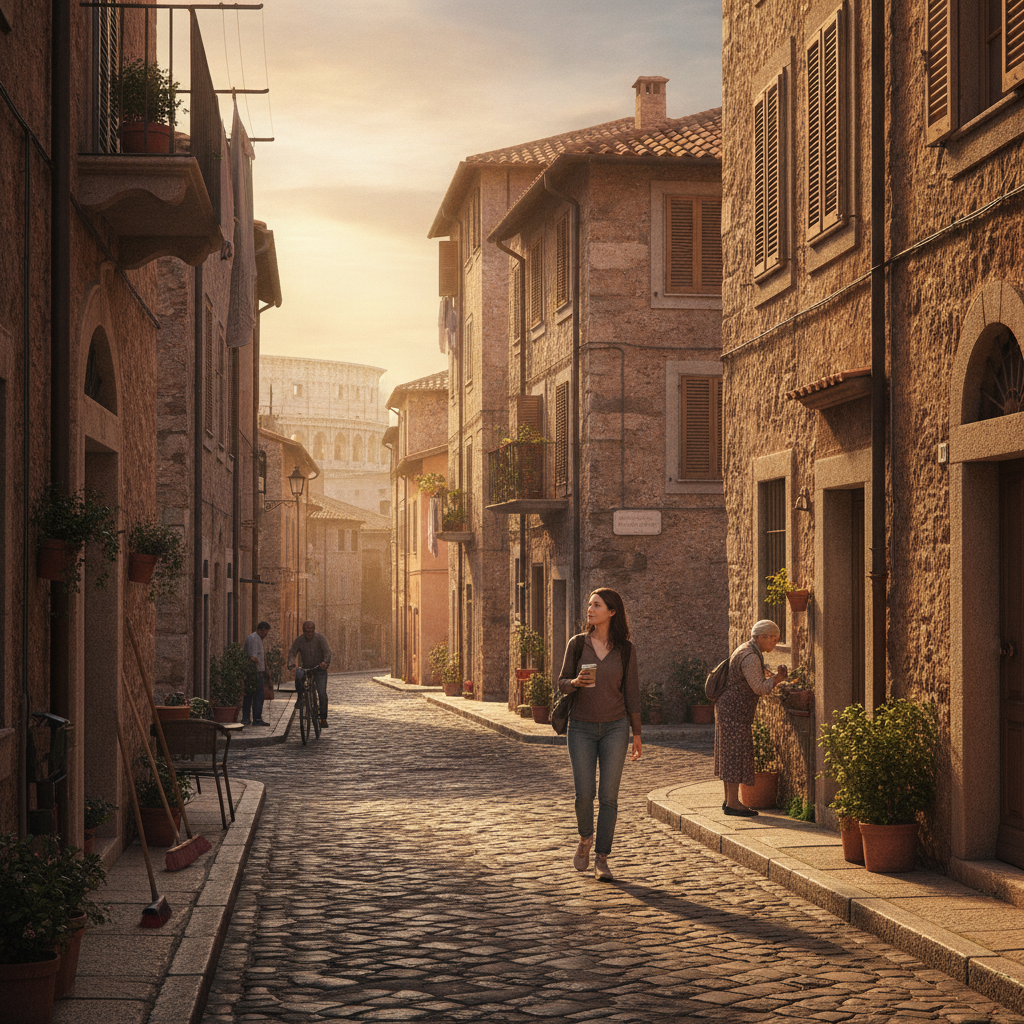
The way a traveler spends the first few hours in a new place quietly determines the shape of everything that follows. That opening morning — still jet-lagged, still adjusting, still seeing with fresh and uncalibrated eyes — is perhaps the most valuable window the entire trip offers. Most people fill it with the obvious: a famous square, a landmark cathedral, a museum queue. Those choices aren't wrong, but they impose a kind of interpretive frame before the traveler has had any chance to develop one of their own. There is another way, and it begins not with a monument but with a street.
The Logic of Starting with the Ordinary
Oldest residential neighborhoods carry something that purpose-built tourist districts have largely been polished out of — the actual texture of daily life. When a traveler walks through Alfama in Lisbon, or the Jordaan in Amsterdam, or Canggu's quieter residential lanes before the surf crowd wakes, they are not encountering a curated version of a place. They are encountering the place itself: the rhythms of morning errands, the smell of bread from a window, the particular way neighbors acknowledge each other on a narrow street. These details are not spectacular, but they are true. And truth, at the start of a trip, is worth more than spectacle, because it gives the traveler a reference point — a kind of emotional baseline — against which everything else can be measured. The landmark seen on day three, after this grounding, becomes richer for it.
There is a concept in cultural anthropology called *mise en situation* — loosely, the idea of being placed within a situation before being asked to interpret it. Tourists who move directly from airport to attraction skip this placement entirely. They arrive at significance without context, and the result is often a kind of hollowness: the photograph is taken, the box is checked, but the experience doesn't settle. The residential morning solves this. It places the traveler inside ordinary life before asking them to make sense of extraordinary things.
What the Neighborhood Teaches That the Guidebook Cannot
A neighborhood's oldest residential quarter is effectively an unedited archive. Streets in places like Naples' Quartieri Spagnoli or Istanbul's Balat district hold centuries of architectural decisions, demographic shifts, and economic histories all layered on top of each other without interpretation. There are no plaques explaining why a particular building looks the way it does, no audio guides narrating the significance of a doorway. The traveler is simply present, and in that presence, pattern recognition begins to develop naturally. The eye starts to notice what is repeated — a particular style of iron balcony, a certain configuration of market stall, the way religious symbols appear or disappear from facades as you move between blocks. This kind of observation, developed through unhurried walking rather than guided narration, builds a kind of fluency that transforms the rest of the trip. Paid attractions and formal sites become legible in a way they wouldn't have been otherwise.
There's also the practical intelligence that comes from a slow residential morning. A traveler who walks through a working neighborhood learns where locals actually eat, which cafés are full of residents and which are empty until tour groups arrive, and what a reasonable price looks like for coffee or a pastry. This knowledge — gathered before the tourist infrastructure of the day fully activates — becomes a quiet compass that guides better decisions for the rest of the stay. The traveler who has sat with a cortado at a neighborhood counter before 8 a.m. knows, intuitively, when they're being overcharged later.
Recalibration as a Travel Strategy
The word recalibration is worth taking seriously here. A measuring instrument that hasn't been calibrated produces readings that are technically coherent but quietly wrong. The same thing happens to travelers who move through a destination without ever establishing a baseline sense of ordinary life. Their impressions accumulate, but they don't add up to understanding — they add up to a kind of highlight reel that feels thinner, in retrospect, than the trip deserved to be. The residential morning functions as calibration. It sets the instrument before it's asked to measure anything important.
For travelers who adopt this practice consistently, the effect compounds across destinations. Someone who has spent first mornings in working neighborhoods across a dozen cities begins to develop a comparative sensitivity — an ability to notice quickly what is distinctive about a place because they have a richer sense of what is universal. The particular way a particular city smells before its tourist economy wakes up becomes a kind of signature. The pace of pedestrian traffic, the ratio of silence to sound, the temperature at which coffee is habitually served — these micro-details accumulate into genuine cultural literacy, the kind that no amount of landmark-visiting alone can build.
Making the Practice Work in Practice
The simplest version of this approach requires almost no planning. Before arriving, identify the oldest residential district within walking distance of your accommodation — not the historic center that has been converted into boutiques and restaurants, but the one where people actually live. In cities like Porto, this might mean heading uphill toward Bonfim rather than toward the riverfront. In Kyoto, it might mean choosing Nishiki's surrounding streets at dawn rather than the covered market itself, which doesn't open until later. Set no agenda beyond walking for ninety minutes. Bring cash for a coffee or a small purchase from a market stall. Leave the earphones behind.
What you'll find, almost without exception, is that this unhurried opening reorients the entire trip. The rest of the day's plans — even the famous ones — become easier to inhabit. You've already been somewhere real. The landmark, when you finally reach it, arrives in context rather than in isolation, and that context is one you built yourself, through observation rather than instruction. The trip, from that point forward, feels less like a sequence of scheduled experiences and more like a developing understanding of a place — which is, in the end, what most travelers were hoping for when they booked the flight.