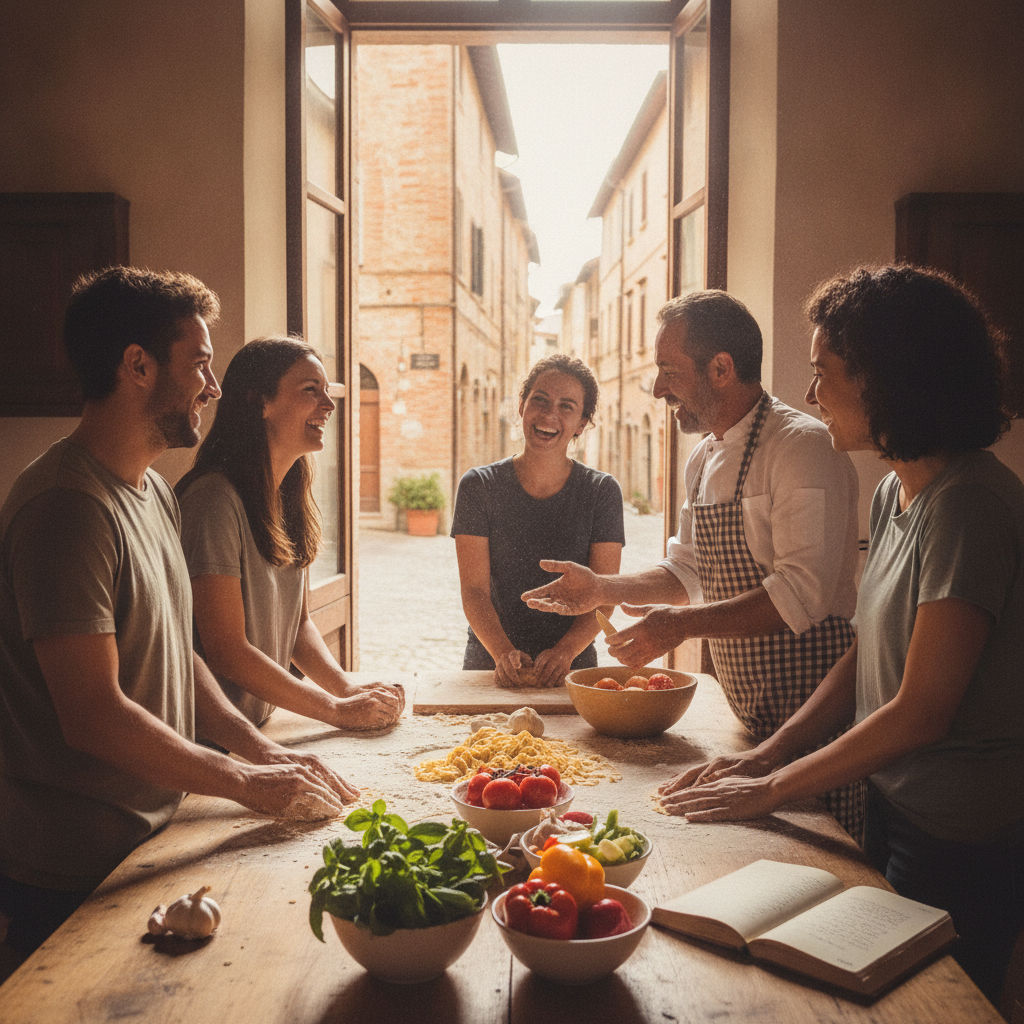
Travel has a way of resisting depth until something forces you to slow down long enough to actually absorb where you are. Most itineraries are built around landmarks, neighborhoods, and transit logistics — all useful, but none of them reliably pull a traveler into the rhythm of daily local life the way food does. A single cooking class, strategically placed on the second day of a trip, has an almost structural effect on how the rest of the experience unfolds. It reorients priorities, opens unexpected conversations, and gives every meal that follows a layer of meaning that no guidebook can manufacture.
Why the Second Day Is the Right Moment
The timing matters more than it might seem at first. Arriving on day one typically means managing fatigue, orientation, and the low-grade disorientation of a new place. By the second morning, the edge has softened — you know where things are, you've slept, and you're curious in a more focused way. A cooking class on that second day catches you at exactly the right point of openness, before routine has set in and before you've established the kind of tourist habits that keep you eating at the same cluster of well-reviewed restaurants near your accommodation. It interrupts that tendency before it starts.
The class itself is rarely just about cooking. Instructors — often home cooks or small culinary school operators rather than celebrity chefs — tend to structure their sessions around ingredients first. You'll visit a market before a kitchen, handle produce you may have only seen in photographs, and learn to identify the spices that anchor a cuisine rather than merely garnish it. In places like Chiang Mai, Oaxaca, or Bologna, the morning market walk that precedes the class is frequently described by travelers as the most illuminating hour of an entire trip. That's not an accident — it's the design.
How One Class Changes Every Meal That Follows
Once you've spent three or four hours learning to build a dish from scratch — understanding why certain ingredients appear together, how heat is managed, what separates a local version of something from the tourist-adapted version — you bring that knowledge to every subsequent meal. A bowl of soup ordered at a street stall three days later carries different weight when you've already stood over a pot and worked through the same base. You notice things: the texture, the proportion of a key ingredient, whether the cook has taken a shortcut that the class instructor warned you about. The experience transforms passive eating into something closer to active reading.
This shift also changes how travelers spend their food budget. When you understand what you're eating, you're less likely to default to expensive options out of uncertainty. Confidence with unfamiliar menus reduces the appeal of restaurants that exist primarily to translate local food into something reassuring for visitors. Platforms like Airbnb Experiences, EatWith, and Cookly all list local cooking sessions across hundreds of destinations, many of them priced well below a single restaurant dinner for two, yet delivering several hours of structured immersion. Booking through these platforms also tends to surface smaller, independently run classes that are embedded in actual neighborhoods rather than tourist corridors.
Finding the Right Class Before You Arrive
Researching and booking before departure is worth the small effort. Classes in popular destinations fill up quickly, particularly during peak travel seasons, and the best ones — those run by locals with long-standing community ties — aren't always the most prominently advertised. Using a platform like Viator or Cookly to filter by neighborhood rather than just by city often surfaces options that are geographically closer to how residents actually live. A class held in a residential apartment or a family kitchen typically delivers more cultural texture than one conducted in a purpose-built tourism facility, even when the cuisine taught is identical.
When evaluating options, consider what's included beyond the cooking itself. A class that incorporates a market visit, provides a printed recipe card in the local language, and ends with a shared meal around a table is doing more than teaching technique — it's modeling the social structure around which food exists in that culture. In many destinations, this final shared meal is when the most candid conversations happen: about local ingredients that are disappearing, about how regional recipes vary from family to family, about what people actually eat at home versus what they serve at celebrations. These details don't appear in travel articles, and they're rarely volunteered to someone simply wandering through a market alone.
The Ripple Effect on Shopping, Eating, and Exploring
The downstream effects of a well-chosen class tend to extend beyond meals. Travelers who've learned even the basics of a local cuisine often start making small purchases in neighborhood grocery stores or spice markets — a bag of a specific dried chile, a particular fermented paste, a seed blend used in the sauce they made. These purchases change the shape of a day. A stop at a neighborhood grocery store that stocks the same brand of fish sauce used in the class becomes a twenty-minute cultural experience rather than a quick errand. The traveler is no longer a spectator in the food environment of a place; they've become, in a small but meaningful way, a participant.
That shift in posture — from observer to participant — is what the second-day class accomplishes at a structural level. It gives the trip a through-line organized around local food culture, and that through-line proves surprisingly durable. Destination cities with strong culinary identities — think San Sebastián, Penang, or Tbilisi — reveal themselves most generously to travelers who've been given a framework for understanding what they're tasting. The class provides that framework early enough to shape everything that follows, rather than arriving as a pleasant but isolated experience at the trip's midpoint.
There's a version of travel that happens entirely on the surface of a place, collecting images and checking locations. And then there's the version that builds genuine familiarity, the kind that makes a destination feel less like a backdrop and more like somewhere you actually spent time. A single cooking class, placed deliberately at the start of a trip, tilts the experience quietly and consistently toward the second version — not by adding something exotic, but by giving you the tools to pay better attention to what's already there.